
A pub website has one job on a Friday afternoon
Somebody within ten miles of you is holding a phone and deciding where to go tonight. They want three things, fast: is it open, what's on and can I book. Most pub websites answer none of them — the opening hours are wrong, the gig list stopped in March, and the only way to find out about the function room is to ring during service.
That's the whole brief. Everything else on a pub or restaurant site is decoration until those three are right, kept right, and readable by Google.
Designed for the pub, and updated by the pub
The Old Mill Inn, Holbury — a bespoke New Forest pub website with a management page the bar team run themselves.
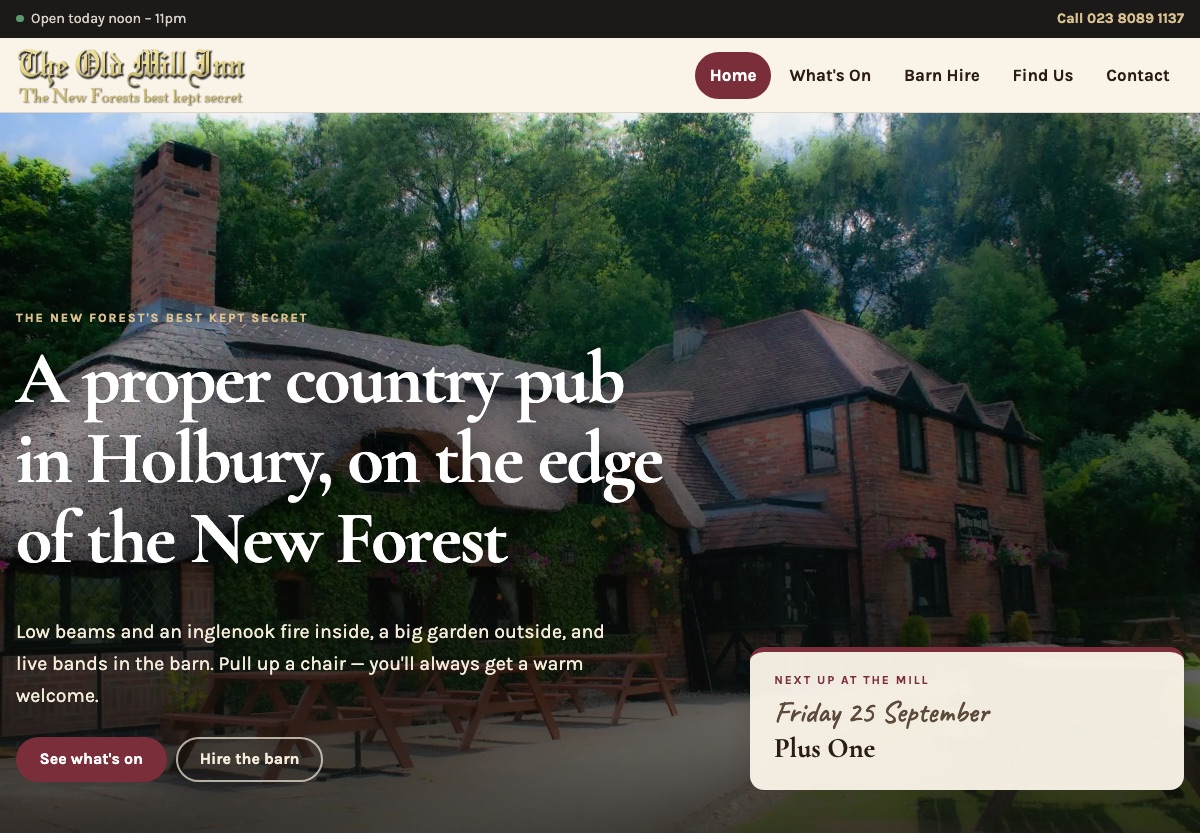

The manager the bar team sign into


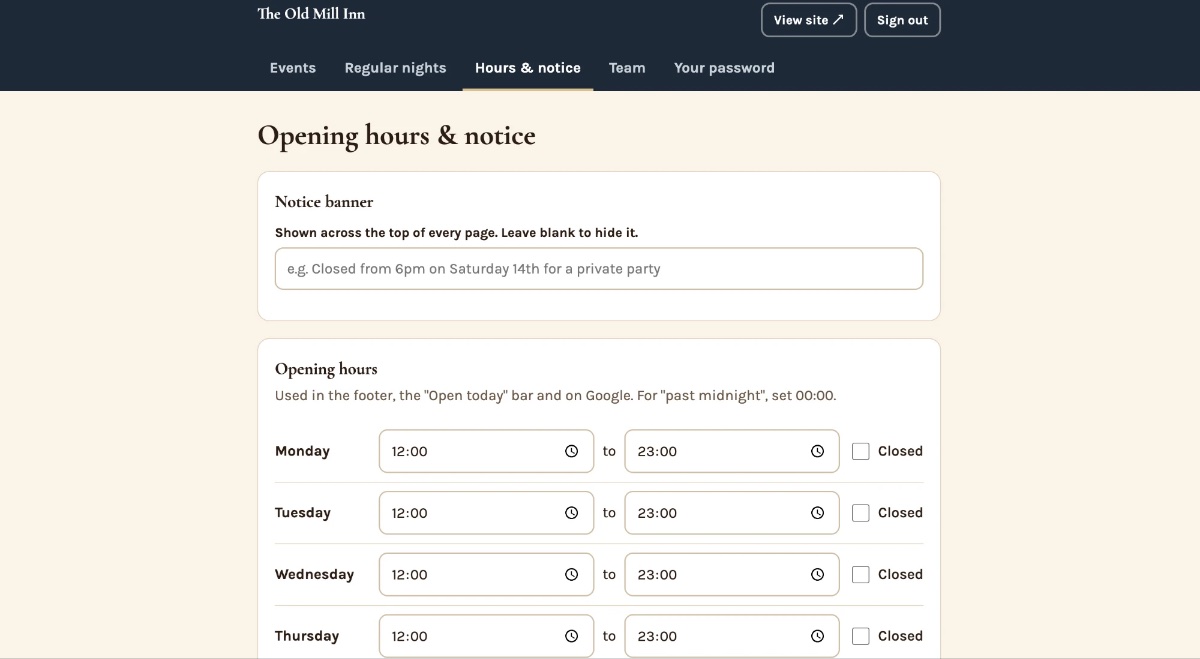
A design drawn from the pub
Nothing here came out of a template. The Old Mill is a thatched country pub on the edge of the New Forest with low beams, an inglenook fire and a barn that holds a hundred and fifty people, so the site was built to feel like walking in: the pub's own photography full-bleed, warm claret and cream, and a typeface matched to the sign over the door.
Underneath it is hand-built PHP — no page builder, no plugin stack, nothing to update on a Sunday night. Every event is rendered by the server with Event and MusicEvent structured data, so a gig at the Mill can show in Google with its date and time attached rather than sitting invisible inside a Facebook post.
I've run venues, not just built sites for them
Before any of this I spent years turning around pubs and late-night venues. I know what a quiet Tuesday costs, why the function diary matters more than the menu page, and how little time anyone behind a bar has to fight a website. That's not research — it's the job I used to do, and it shapes every decision on a hospitality build.
The bit landlords actually care about
The pub asked for one thing above everything else: change what's on without ringing anyone. So the site has its own management page. Sign in, and you get plain tabs — not a CMS.
- Events — add a band, a date, a time and a poster. Upload the photo straight off the phone and it's resized and stripped of location data for you.
- Regular nights — anything that repeats weekly, set once.
- Opening hours — change them here and they change in the top bar, on the contact page and in the data Google reads, all at once.
- Notice banner — a kitchen closed, a bank holiday, a one-off — site-wide in seconds.
- Copy an event — last month's band back again? Duplicate and change the date.
- Its own team — a login each, with the owner able to add and remove staff.
Every change is live everywhere the moment it's saved — the What's On page, the homepage panel, the hours in the header, the structured data. Past events tidy themselves away automatically, so the page never shows a gig from last spring.
And it grows with the pub
What's On, hours and a notice banner is where The Old Mill started, because that's what they needed first. The manager isn't a fixed product — it's your software, so anything else your pub runs on can be added to it.
Daytime and evening menus
Two menus, three, or a different one every day. Lunch, evening, Sunday roast, small plates, kids' and specials — each edited on its own tab, with prices and dietary marks you change yourself when the supplier price moves.
They can switch over on their own at a set time, so the site shows the evening menu from six without anyone touching it, and they're published as real text rather than a PDF — so dishes are searchable and readable on a phone.
Table booking
Embed the system you already pay for, or have one built in: covers and sittings, party size, deposits on the big bookings, confirmation and reminder emails, and a diary the floor can actually read on a busy Saturday.
Function and private hire sit alongside it, with the questions you'd otherwise be ringing back to ask already answered on the form.
Whatever else the pub runs on
Rooms and availability. Gift vouchers sold online. A quiz or darts league table. Takeaway and collection ordering. A photo gallery the staff upload to. Mailing list signups. Staff notices and rotas behind the same sign-in.
None of it is a plugin hunt — it's a change to software I wrote, so it works the way your pub works rather than the way a plugin author assumed.
Start with what you need now and add the rest when it earns its place. Tell me how the pub runs and I'll tell you honestly what's worth building first.
I've stood on the other side of the bar
My background isn't only web. I spent years turning around pubs and late-night venues — running the door, the diary, the entertainment and the numbers. I know what a dead Wednesday does to a week's takings, why a confirmed function is worth ten covers, and exactly how much appetite a landlord has for logging into something complicated at midnight. None.
So when we talk about your website, you won't be explaining the trade to me. We'll be talking about what fills the room.
It's the same reason the Nostalgic DJ build went the way it did — I DJ'd in clubs for years, so I knew what a booker needs to see before they'll part with a deposit.
The diary fills itself
Function, barn and party hire enquiries captured as a proper form, with the questions you'd have had to ring back and ask.
Live music that gets found
Every gig marked up so Google can show it as an event, with the date, the time and the venue attached.
Hours in one place
Change them once. Header, contact page, footer and structured data all follow.
Found by town
Built to rank for the pub, the village and the searches that bring people in from the next one over.
What I build into a pub or restaurant website
- What's On, kept current by you — a manager page where bands, quiz nights, bank holidays and one-offs are added in a minute, from a phone, behind the bar
- Opening hours as data, not a picture — so they're right on the site and right in the panel Google shows next to your name
- Menus that can be read — as real text, not a PDF nobody can pinch-zoom, so dishes and dietary lines are searchable
- Function and private hire — its own page, its own enquiry form, its own photographs, because that's the highest-value enquiry you get
- Table booking — your existing system embedded, or a straight enquiry form if you'd rather keep the phone
- Event structured data — MusicEvent and Event markup on every listing, plus BarOrPub or Restaurant markup site-wide
- Local SEO — the village, the town and the "near me" searches, tied to your Google Business Profile
- Fast on a phone on pub wi-fi — hand-built, no page-builder bloat, nothing to slow it down
Pubs, restaurants, bars and hotels
The same approach fits a village local, a gastropub, a restaurant with a tasting menu, a late bar or a small hotel — the balance changes, but the questions the visitor is asking don't. If you're weighing up a WordPress build against a hand-coded site, that's worth ten minutes on the phone before anyone designs anything.