

A website's job is to get you work
You have about three seconds. In that time a visitor decides whether your business looks like the right one for them — before they've read a word. Layout, colour, photography and speed do that work, and they do it whether you've thought about them or not.
So I don't start with a theme. I start with who you're selling to, what they need to see, and what you want them to do next. Then I build the design around that, and make sure the thing loads fast enough that they stay.
What's included as standard
- Custom design — not a stock template with your logo dropped in
- Mobile-first build, tested on real phones, not just a resized browser
- Technical SEO from day one: structure, headings, schema, sitemaps
- Fast hosting, free SSL and daily backups
- Enquiry forms with spam protection that doesn't annoy real customers
- Google Analytics and Search Console set up and verified
- Training if you want to update it yourself
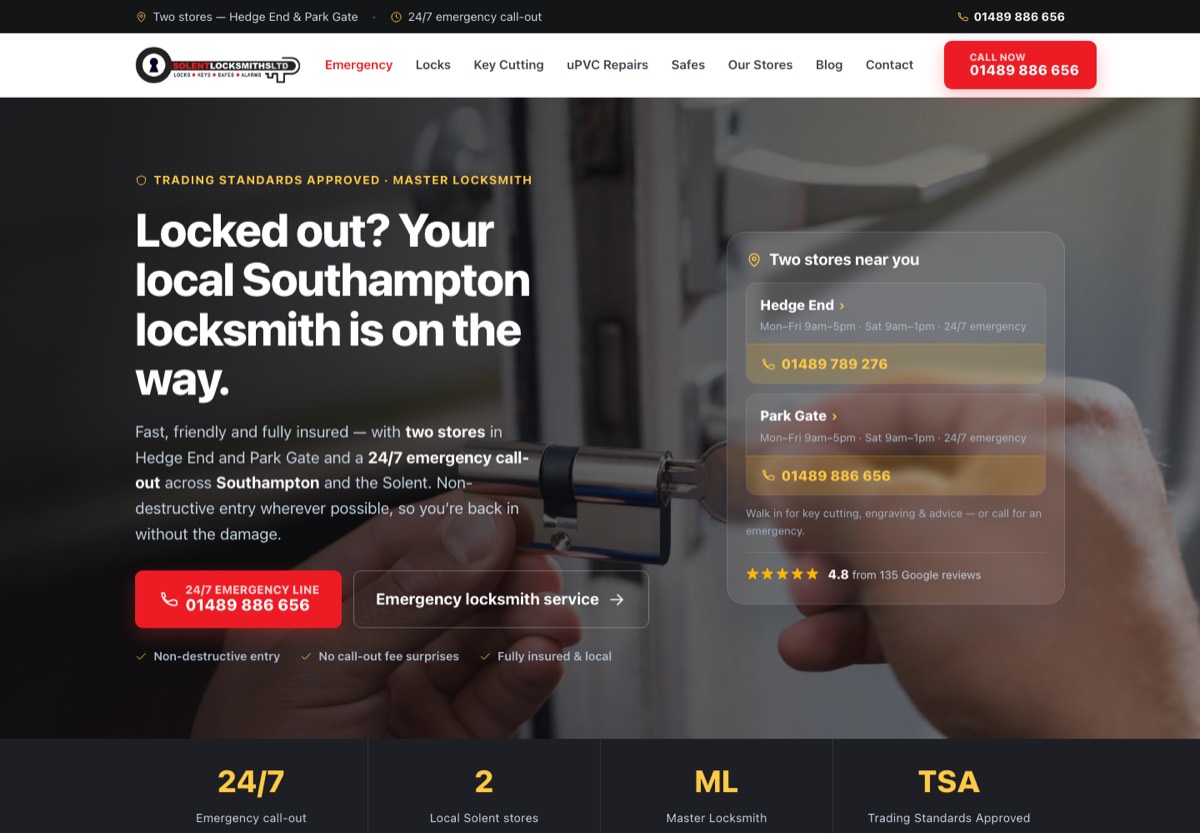
What's on the screen is about 25% of the job
The design is the quarter you look at. The other three quarters happen behind it — and that's the part that decides whether the site is safe, whether it's fast, and whether anyone ever finds it.
The site itself is secure
Most hacked small-business sites aren't targeted — they're found by a bot sweeping the internet for an out-of-date plugin. So the build starts from the other end: no CMS at all where you don't need one, a lean and patched one where you do, hardened file permissions, SSL, and nothing exposed that doesn't have to be.
I've rebuilt enough hacked sites to know what it costs a business: suspended by the host, spam pages in Google, customers seeing a warning screen and weeks of ranking gone. Cheaper to build it properly.
The forms are secure
Your contact form is the one door you deliberately leave open, which is exactly why it gets attacked. Done badly it becomes a spam relay that gets your domain blacklisted, or a way into the site itself.
Mine are built with layered defences — honeypots, rate limiting, strict validation, header-injection protection and a logged copy of every enquiry kept outside the web root, so a message is never lost if email hiccups. And no CAPTCHA puzzle to annoy the genuine customer.
It's optimised for speed and weight
Weight is the thing nobody sees and everybody feels. A homepage carrying eight megabytes of unoptimised photography and four plugin stylesheets will lose people on a phone with a bar and a half of signal — and they never tell you why they left.
So images are sized and compressed properly, code is kept to what the page actually uses, render-blocking scripts are cut back, and caching and a CDN do the rest. Speed is also a ranking factor, so this one pays twice.
It's search engine optimised from the start
A beautiful website nobody can find is an expensive business card. Technical search engine optimisation is built in on day one, not sold as an extra later: a page for each thing you want to be found for, clean URLs, proper headings, written titles and descriptions, structured data, XML sitemaps that are verified rather than assumed, and Search Console connected before launch.
And when a site is replacing an old one, every existing URL is mapped and redirected — so the rankings you already had come through the move with you.
That back-end quarter is also where your money goes on a cheap build — nowhere. It's the easiest corner to cut, and the only one you can't see until it costs you. More on that in what free and cheap websites leave out.
Which type of website do you need?
Three different builds, three different jobs. I'll tell you honestly which one fits — including when the cheapest option is the right one.
Fast HTML websites
Hand-coded, no CMS. Nothing to hack, nothing to update, and about as fast as the web gets. Ideal for brochure sites and trade businesses.
Find out moreCMS websites
WordPress, set up properly. For businesses that add news, projects or products regularly and want to do it themselves.
Find out moreEcommerce websites
WooCommerce stores built to trade at real volume, with stock, payments, delivery rules and deals handled properly.
Find out moreWebsite design for your industry
The build is only half the answer. What a pub needs from a website has almost nothing in common with what an online shop needs, or a garage, or a firm of tradespeople — different visitors, different questions, different searches. So the work is grouped by trade, with real live examples of each:
- Pub website design and restaurant website design — What's On your own staff update, function and hire enquiries, and opening hours Google can actually read
- Ecommerce website examples — WooCommerce shops with honest stock, working deals and products people can find
- Garage website design — servicing, MOT and marque pages built to win the local search and the map pack
- Business website design — trades, workshops, practices and local specialists who win work by being found
Local to you
I'm based in Hythe and work with businesses across Southampton and Hampshire, but most of my clients are close to home. There are pages on web design in Hythe and Dibden Purlieu, covering the Waterside from Marchwood to Fawley, and on web design in Totton and the New Forest.
How a project runs
Talk
A proper conversation about your business, your customers and what the site has to achieve. No charge, no pressure.
Fixed quote
A written price and a scope. If something changes later I'll tell you what it costs before I do it.
Design & build
You see the design before it's built, and the build on a staging link before it goes live.
Launch & after
Go live, analytics verified, then ongoing support and hosting if you want it.
Frequently asked