


Published
On this page
If you're starting an online shop, or outgrowing the one you have, the choice usually comes down to Shopify or WooCommerce. Both are good. They suit different businesses, and the differences matter more as you grow.
The short version
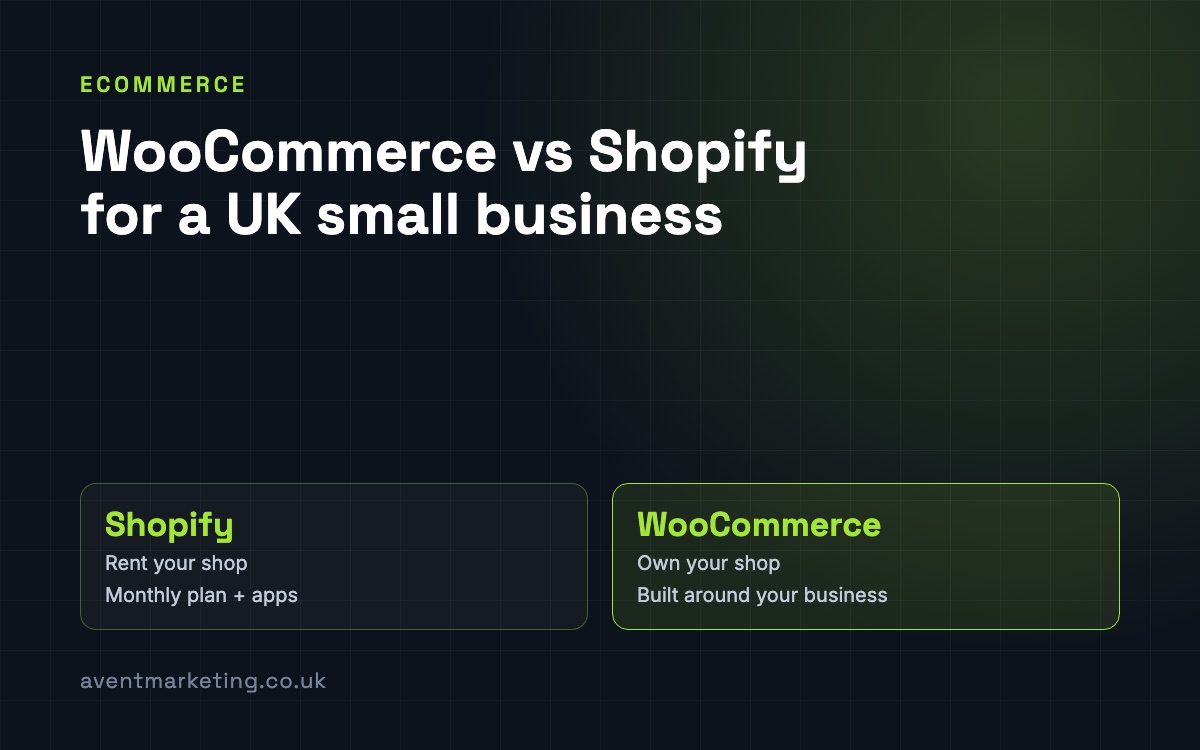
Shopify is a hosted service: you rent your shop, they look after the technical side, and you pay a monthly fee. WooCommerce is free software that runs on WordPress: you own the shop outright and host it yourself, or have someone host it for you.
Renting is easier to start. Owning gives you more control, and usually costs less as you grow.
What Shopify does well
- Quick to get going, with no hosting to arrange.
- Security, updates and uptime handled for you.
- A large app store for adding features.
- Built-in payments and a point-of-sale option.
For a small catalogue, a straightforward business, and someone who wants to manage it all themselves, it's a sensible choice.
What WooCommerce does well
- You own it. The shop, the data and the code are yours. Nobody can change the rules or the prices on you.
- No platform cut. WooCommerce doesn't take a percentage of your sales. You pay your payment provider's fees, as you would anywhere.
- It can do anything. Because it's open, unusual pricing, delivery rules, stock across several shops or a link to your till can all be built properly, rather than worked around.
- It's WordPress underneath, which is very good for content and SEO – your shop and your articles live in one place.
Comparing the real costs
The headline monthly price is rarely the true cost. When you compare, add up:
- Platform fees. Shopify's monthly plan, versus WooCommerce's hosting.
- Apps and extensions. On Shopify, many features are monthly subscriptions, and a busy shop can end up paying for a dozen. WooCommerce extensions are often one-off or yearly.
- Transaction fees. Shopify charges an extra fee on each sale if you use a payment provider other than its own. Check the current rates for the plan you're considering.
- Upkeep. WooCommerce needs updates and good hosting. That's real work, and it should be part of the comparison.
Where each hits its limits
Shopify's limits show up when your business does something its way rather than Shopify's: complicated deals, stock shared with physical shops, unusual delivery zones, age verification, or a process that no app quite covers. You end up bending the business to fit the platform.
WooCommerce's limits are usually down to how it was built. A shop stacked with plugins and cheap hosting will be slow and fragile. Built properly, on good hosting, it runs very large shops. The White Vape Co store I built runs three shops, a website and an app from one stock system, with deals that work identically everywhere – something no off-the-shelf platform does out of the box.
Which should you choose?
- Choose Shopify if you have a simple range, want to do it yourself, and value convenience over control.
- Choose WooCommerce if you want to own your shop, expect to grow, have physical shops as well, or need it to work the way your business works.
I build on WooCommerce for exactly those reasons, and when a shop needs something unusual I write bespoke WooCommerce plugins to do it. If you're weighing up the move, that's a conversation I have often as part of ecommerce web design in Southampton, and it should always include managed web hosting sized for the shop.